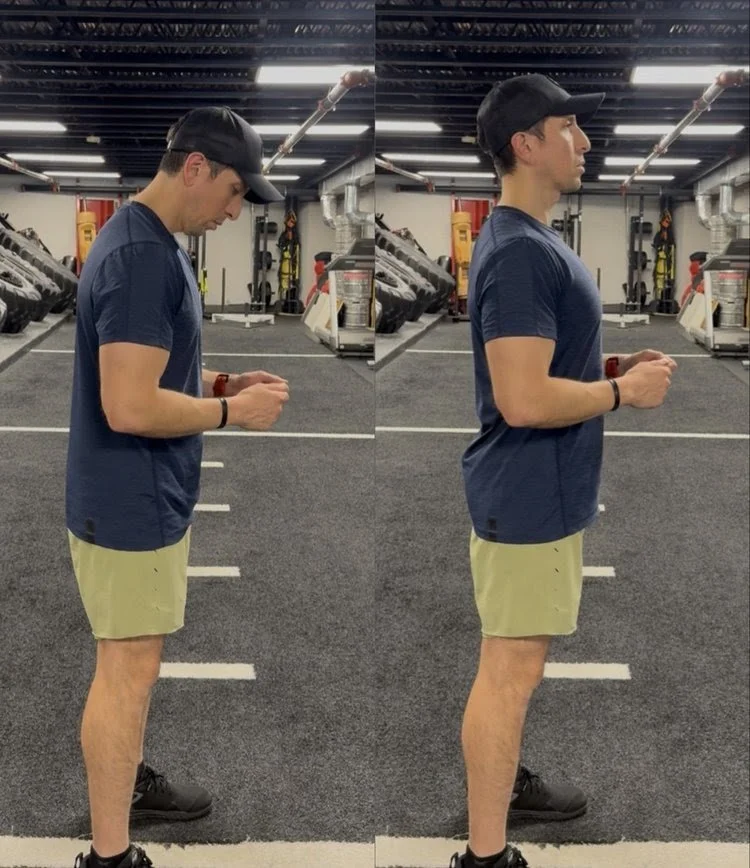
Next time you’re in a room with other people, whether it’s at the office or at a family gathering, pause to notice everyone’s head posture. Chances are that a good portion of those individuals have forward head posture.
The forward leaning of the head may be initially caused by something drawing the individual’s head forward. This could be a book, television, phone, laptop, tablet, or anything that forces the head to look down for an extended period of time. Just take a look at the picture above (left) to see what looking down does to the neck.
Over time, muscles in that region begin to weaken. The upper back muscles get weak and allow your upper back to round out. Your deep neck flexors also get weak and allow your head to stay shifted forward.
The combination of the forward leaning habits and the weakening muscles is no match for the gravitational pull, which makes the problem significantly worse.
The head is heavy. A popular study by Dr. Kenneth K. Hansraj in Surgical Technology International used a computer model of the cervical spine to calculate the exact stress generated at different angles of forward head flexion. At 0º (or neutral) the force on the cervical spine is 10 to 12 pounds. Leaning forward just 15º increases the force to about 27 pounds. But most people lean forward about 45 to 60º. A lean of 45º is 49 pounds and 60º is 60 pounds! Luckily, we have muscles, tendons, and bones to help distribute the weight. However, this is still a lot of load.
If you are not strengthening your neck muscles, then you are losing a battle very quickly. It’s never too late to start. Below are two exercises I love to give my clients to help them with their neck posture.
Important note: The neck can be a very delicate area to exercise. I recommend performing these exercises under the supervision of a trained professional.
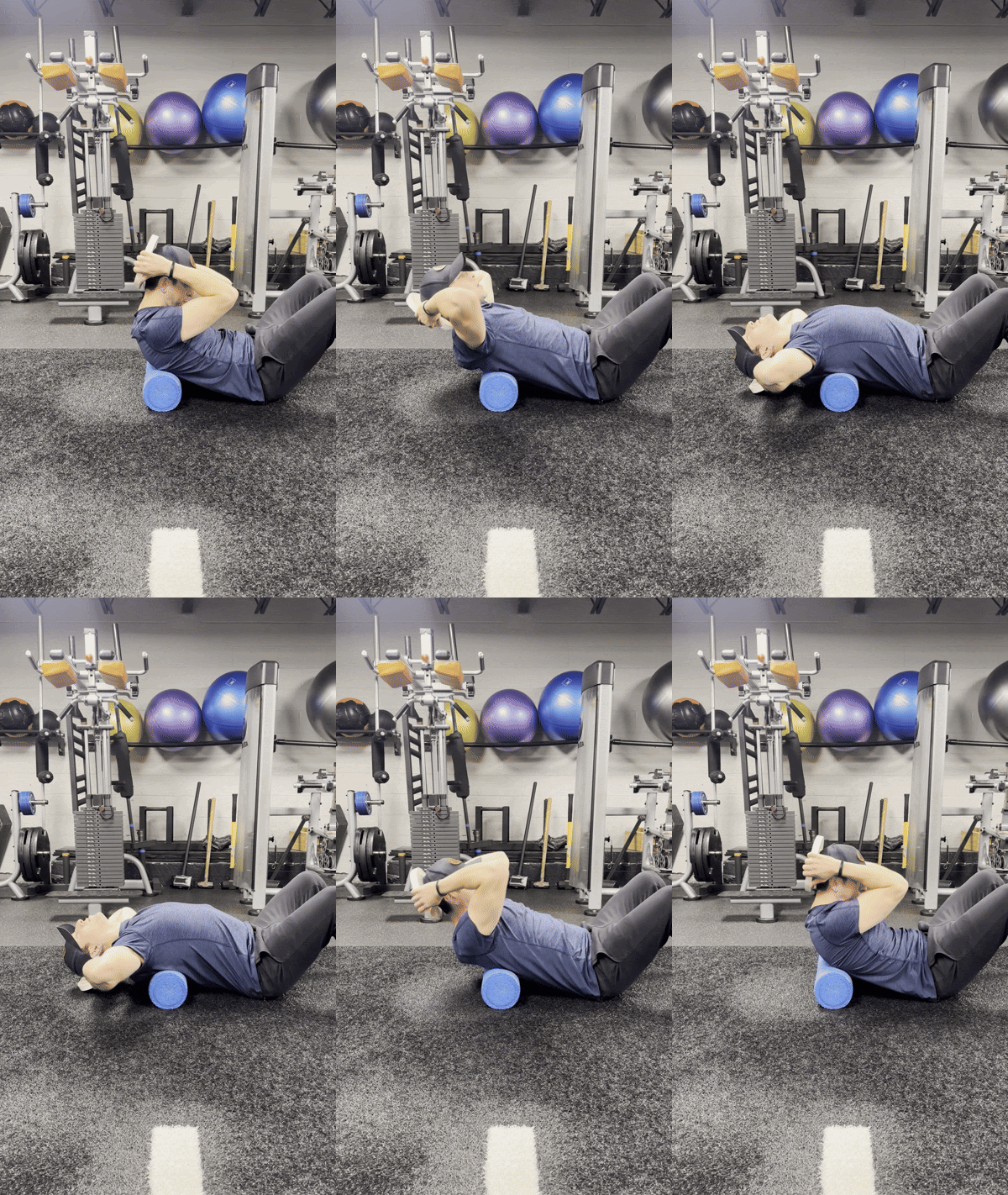
Foam Roller Thoracic Extension
This mobility exercise helps reverse that hunched over position by putting the upper spine (thoracic spine) in an extended position. I make a few tweaks to the traditional method to help you get a deeper stretch.
Place the foam roller on the floor. Sit in front of it and lie back so the roller rests perpendicular (crosswise) to your spine, just below your shoulder blades (mid-back).
Lace your fingers behind your head to support your neck. Do not pull on your neck during the movement.
While keeping your knees bent, feet flat on the floor, and butt on the floor, gently extend back allowing the spine to fold over the roller. As you lean back, I want you to push your head into your hands and inhale deeply.
Hold the extended position for 2 to 3 seconds, then crunch back up as you exhale. At the very top, drive the elbows close together and tuck the chin to work a greater range of motion.
If you want a deeper stretch, add a weight behind your head to help pull you into a deeper extension.
Perform 1-2 sets of 6-10 repetitions.
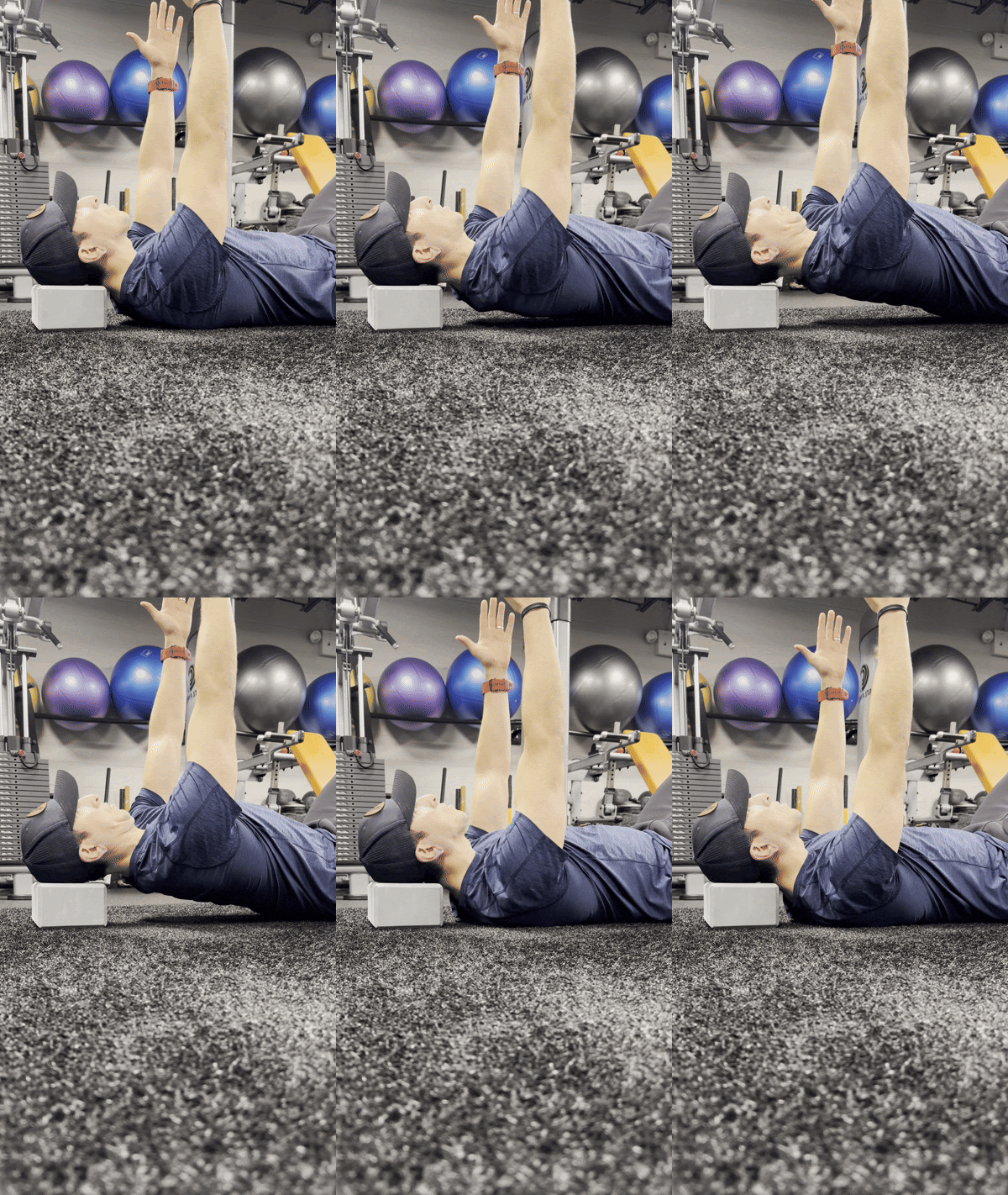
Loaded Chin Tuck
This is a strengthening exercise that targets the deep neck flexors that pull your head back into alignment. It also works the upper back muscles that keep you upright. This is an advanced movement. If the yoga block is too much strain on the neck and upper back, stick with a normal chin tuck (no yoga block).
Lie flat on your back with your knees bent, feet flat, and hands face down on the floor.
Place a yoga block underneath your head. Relax your shoulders and neck allowing your upper back to shift toward the floor. Your face should be facing the ceiling at all times.
Using the assistance of your arms on the floor, perform a chin tuck by pushing the back of your head into the yoga block. This will force your torso to shift up into a more neutral spine alignment. In order to get the “double chin position” it’s important to keep the chin completely still.
Hold at the top for a fraction of a second, and gently return to the floor without moving the chin.
If you want a more loaded variation, reach your arms toward the ceiling. The exercise is more difficult without arm support on the floor.
Perform 2-3 sets of 6-10 repetitions.